
Most key rabi-producing states of north India, such as Madhya Pradesh and Rajasthan, have staggered their procurement to enable farmers to come in batches, so that there is no overcrowding. The Centre has also set up a call centre to coordinate the inter-state movement of farm commodities.

Retail sales of overall vehicles in India grew by 15.28 per cent to 2,11,20,441 units in 2022 led by record sales of passenger vehicles and tractors, Federation of Automobile Dealers Associations (FADA) said on Thursday. In 2021, total retail sales of vehicles in India were at 1,83,21,760 units, FADA said in a statement. Two-wheelers retail sales stood at 1,53,88,062 units last year, a growth of 13.37 per cent from 2021 when sales stood at 1,35,73,682 units.

>The farmers will go home but the country will not get the agricultural reform it badly needs -- if nothing else, then to prevent a bigger water crisis than already exists, argues T N Ninan.

In the past month, wheat prices have increased 6.3% as production is expected to be 1.5% lower, in terms of crop acreage, than the earlier estimate
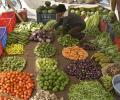
In most cases, however, retail consumers are paying higher prices in the absence of direct procurement from aggregator or farmers.

'Will you declare MSP for 100 odd crops that the farmers of India grow?'

In the early part of 1800, a 30-acre plot next to Fort Gloster on the banks of river Hooghly in Howrah district of Bengal was the nerve centre of industrial activity; it housed India's first steam-powered cotton mill, Bowreah Mills, which was set up by a British merchant and went on to become a hub of factories - a rum distillery, foundry, cotton yarn factory, an oil mill and a paper mill, et al. Spearheaded by Dwarkanath Tagore, the industrialist grandfather of Rabindranath Tagore, the commercial complex was possibly the first of its kind in the country. Close to 200 years later, after much ebb and flow of history, the hub is set for a resurgence of sorts.

Days after their passage in the Lok Sabha, Tomar introduced the Farmer's Produce Trade and Commerce (Promotion and Facilitation) Bill, 2020, and the Farmers (Empowerment and Protection) Agreement of Price Assurance and Farm Services Bill, 2020 in the Rajya Sabha.

The finance ministry on Thursday raised concerns over the possible impact of El Nio conditions on India this year, saying if recent forecasts came true, the country could see lower agricultural output and higher inflation. "Some meteorological agencies predict the return of El Nio conditions in India this year. "If these predictions are accurate, then monsoon rains could be deficient, leading to lower agricultural output and higher prices," the ministry said in its monthly economic review.
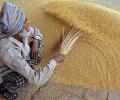
India has banned wheat exports with immediate effect as part of measures to control rising domestic prices, according to official notification. However, the export shipments for which irrevocable letters of credit (LoC) have been issued on or before the date of this notification will be allowed, the Directorate General of Foreign Trade (DGFT) said in a notification dated May 13. "The export policy of wheat ... is prohibited with immediate effect...," the DGFT said. It also clarified that wheat exports will be allowed on the basis of permission granted by the Government of India to other countries to meet their food security needs and based on the request of their governments.

While reforms may translate into new opportunities for firms like ITC, Adani Wilmar and Reliance Retail, farmers are unlikely to use it for fear of upsetting commission agents.

The report admits that converting MSP to a floor price of auction on the eNAM portal will not completely solve the problem as the current data shows that average modal prices in e-NAM mandis is lower than the minimum support price in all commodities except urad.

Kerala on Tuesday became the first state to fix the floor price for vegetables, which would be 20 per cent above the production cost, Chief Minister Pinarayi Vijayan said in Thiruvananthapuram on Tuesday.

The reforms will help FPOs procure directly from farmers, something that they have been pressing for long.
A head of its meeting, the Reserve Bank of India (RBI) can take some solace from the softening food commodity prices. However, the events surrounding the last few weeks show that the fall may not be uniform across all commodities, and cereals like wheat and rice could be the outliers. A Reuters report said that local wheat prices jumped to a record Rs 23,547 per tonne on Wednesday. That is a 12 per cent rise from the recent lows that followed the government's surprise ban on exports on May 14.
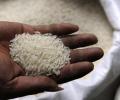
A 6-7 million tonnes shortfall in rice production due to a fall in paddy sowing area is likely to keep rice prices at elevated levels, adding to the inflationary pressure that the slowing economy is already grappling with. Elevated food prices, including that of cereals, had led to retail inflation reversing a three-month declining trend, to touch 7 per cent in August. Similarly, the wholesale price inflation, which declined to 11-month low, also showed price pressures from cereals resulting from wheat output being impacted by severe heat waves in some parts of the country.

The minimum support price for the rabi season will not radically alter the falling trajectory of farm incomes

The NITI Aayog, in a concept note floated a few months back, had suggested three models of procurement but the Centre, at least for the time being, has decided to rely on existing PSS schemes along with giving states the option of choosing Bhawantar Bhugtan for oilseeds.
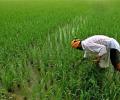
Prime Minister Narendra Modi on Saturday released Rs 20,946 crore to 10.09 crore farmers across India as the 10th installment of financial aid under the PM-KISAN scheme and said there was a need for innovation in agriculture along with promotion of natural farming. Under the Pradhan Mantri Kisan Samman Nidhi (PM-KISAN) scheme, a financial benefit of Rs 6,000 per year is provided to the eligible farmer families, payable in three equal installments of Rs 2,000. The PM-KISAN scheme was announced in the February 2019 Budget.

The agriculture minister said the government's constant efforts are aimed at making farmers prosperous by increasing their income.

The protesting farmers celebrated Holi at the borders and maintained that their agitation will continue till the farm laws are repealed and a separate law on minimum support price is enacted, it said in a statement.
The government and farmer unions have held 11 rounds of talks so far, the last being on January 22, to break the deadlock and end the farmers' protest. Talks have not resumed following widespread violence during a tractor rally by protesting farmers on January 26.

After his visit to Gohana to attend a public rally on Sunday was cancelled due to bad weather, Union Home Minister Amit Shah addressed the gathering briefly over phone and exuded confidence that 'lotus will bloom' on all Lok Sabha seats in the state in 2024 elections.
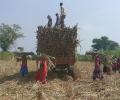
Nitin Tyagi is a young farmer in Budhagaon village of Baghpat district of Uttar Pradesh. A few years ago, Tyagi left his fairly lucrative job in the medical industry and shifted base to his ancestral village to look after his land and property. He opened a small shop selling farm inputs in the village and also started taking a greater interest in agricultural matters which had so far been looked after by his father and uncles. Tyagi and his brothers primarily grow sugarcane, potato and wheat on nearly 10 acres of land with sugarcane taking up most of his time and effort. Being one of the most important and lucrative cash crops of the region, sugarcane is directly linked to the fate of millions of farmers in west UP and with it, the electoral fortunes of political parties seeking their votes in the coming assembly polls.
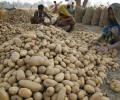
From output surge to lack of cold storage, not much attention has been given to the potato farmers. The export market, too, is bleak, due to unsuitable domestic varieties and an underdeveloped food processing value chain.

Retail prices of tomato had touched almost Rs 80 per kg in major cities owing to short supply and transportation cost over the past few weeks following heavy downpour.

'Some farmers know when elections are due.' 'Before that, they take loans.' 'They then ask their farmer unions for loan waivers and the political party who shouts first about a loan waiver (gets the votes).'
The government's food subsidy in the ongoing fiscal year is expected to be a little less than Rs 4 trillion.
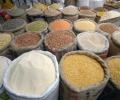
Procurement will be done through domestic purchases as well as imports.

'The cabinet approval is a logical step. It doesn't hold any more significance than what we have already stated on November 19.'

Extended rounds of negotiations having failed, farm leaders now reckon that their best chance to pressure the government lay in defeating the BJP in the coming assembly poll, particularly in UP, observes Virendra Kapoor.

SAD chief Sukhbir Singh Badal announced the decision to snap ties with the NDA on Saturday night, amid stepped up agitation by farmers in Punjab over the three legislations which were recently passed by Parliament amid Opposition protests.
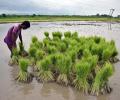
Among the key demands of agitating farmers has been a legal guarantee on minimum support price (MSP). The protest reached a crescendo when thousands of farmers from Punjab and elsewhere marched towards Delhi late last year and decided to block the main entry points once they were denied entry. The Centre, on its part, held 11 rounds of discussions with the protesters and even offered to amend some of the provisions without much success. With now one of their chief demands met, farmers have now moved on to force the government to concede on MSP.

'The decision to supply free food grains is not an economically sound decision because the government will find it very difficult in future to charge anything for food grains.'

Sidhu asserted that he will continue to appear on The Kapil Sharma Show.
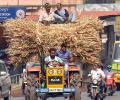
Chand pointed out that the government is willing to discuss the three farm laws clause by clause, and farmer leaders should consider this offer.

'This announcement is big foolishness.' 'The government has no idea of economics. They are just announcing what comes to their mind.' 'Let them implement what they have announced and just see what will happen in two years.'
'The revival of household savings and investment is the litmus test of whether we are on the road to recovery,' says Nitin Desai.
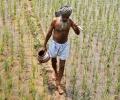
Announcing MSP at an elevated level will not be enough. Growers must be able to procure inputs, such as quality seeds, plant nutrients and irrigation water at reasonable prices, says Kunal Bose.

The Lakhimpur Kheri violence, in which four farmers were killed, is "absolutely condemnable," Finance Minister Nirmala Sitharaman has said, emphasising that there are issues of such nature happening in other parts of India equally which should be raised "when they happen and not when it suits others" because there is a Bharatiya Janata Party government in Uttar Pradesh.
